

Late winter is the best time to prune most trees in Colorado. The Colorado State Forest Service puts the window at mid-February through early March, while the tree is still dormant and just before new growth starts. Dead, broken and diseased branches are the exception. Those can come out in any month.
The rest depends on the tree. Some are pruned in winter to slow the spread of disease. Flowering shrubs are pruned right after they bloom. Pine and spruce need a plan for the cut branches, because of bark beetles.
Key takeaways
- Prune most trees in late winter, mid-February through early March, before the buds open.
- Dead, broken or diseased branches can be removed at any time of year.
- Hold off on major pruning while the leaves are opening in spring, and from early fall to midwinter.
- Apple, crabapple, pear, hawthorn and American elm are pruned in winter because of disease.
- Take no more than a quarter of a tree’s leaves in one year, and much less on an old tree.
Why late winter is the best time
Late winter, from mid-February through early March, is the best time to prune most trees, according to the Colorado State Forest Service. The tree is still dormant, and a cut made just before new growth starts closes faster than one made in early winter.
Colorado State University Extension gives two more reasons in its guide to structural pruning. The tree is carrying a lot of stored energy from the last growing season. And with the leaves off, it is easier to see the branch structure and decide what to cut.
Go by the buds more than the calendar. Once leaf and flower buds start to open, the Forest Service says pruning should wait until the leaves are fully out.
The pruning year in Colorado
| Time of year | Prune live branches? | Why |
|---|---|---|
| Late winter (mid-February to early March) | Yes. Best window for most trees. | The tree is dormant and cuts close quickly once growth starts. |
| Spring, while leaves are opening | Wait. | Bark and wood separate easily during the spring growth flush. |
| Early to midsummer, once leaves are full size and dark green | Yes. | CSU Extension counts this as a good time to prune. |
| Early fall to midwinter | Avoid major pruning. | Fall pruning can interfere with winter hardiness, and cold can crack the wood a cut exposes. |
| Any month | Dead, broken and diseased branches, plus minor pruning on a healthy tree. | CSU says these can be done at any time of year. |
The table follows CSU Extension’s pruning guide. It calls fall “an undesirable time to prune”, and says the same of late fall to midwinter, when cold can crack and damage the wood a cut exposes. You will see fall pruning recommended elsewhere. For major pruning of live branches, CSU advises against it.
Minor pruning is different. The guide allows it on a healthy tree at any time of year. Minor means less than 10 percent of the leaves, or small branches only.
The guide also says not to remove live wood from a tree in drought stress, because the tree is living on what it has stored. After a dry fall, water before you prune.
Trees with their own timing
Maple, birch and walnut
These can drip sap from a cut made in late winter or early spring. The Forest Service says the sap flow should not harm the tree. If it bothers you, prune them in summer, after the leaves have filled out.
Apple, crabapple, pear and hawthorn
These get fire blight, a bacterial disease that can kill branches and whole trees. CSU Extension’s fire blight guide says trees that are prone to it are best pruned in the dormant season, up to one month before the buds break.
Winter also makes the job smaller. In the dormant season, the same guide says to cut a blighted branch at least eight inches below the canker. In summer the cut must be 18 to 24 inches from it.
On a flowering crabapple, finish any pruning by June 1. CSU’s crabapple guide notes that next spring’s flower buds form in June and July.
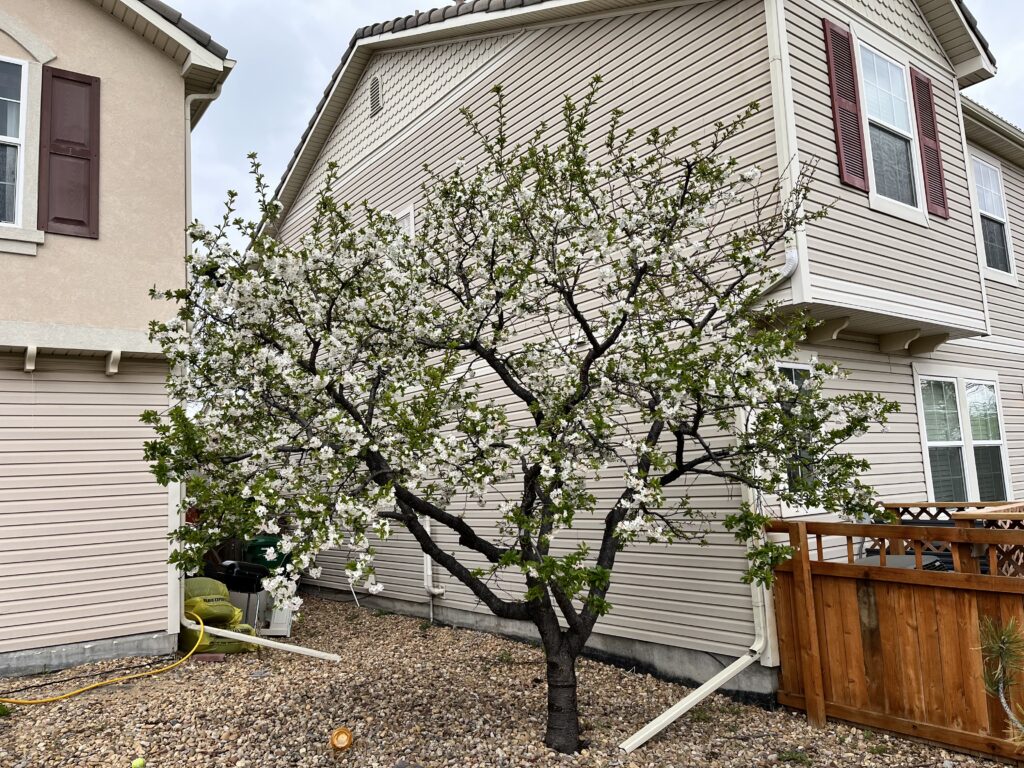
American elm
CSU’s PlantTalk lists American elm with crabapple as trees that should be pruned in winter to limit the spread of disease. Some elms drip sap after a late-winter cut, like maples. It is harmless, so winter is still the time.
Lilac and other spring-flowering shrubs
Spring-flowering shrubs bloom on twigs that grew the summer before. Prune them in fall or winter and you cut off the flower buds. For the most flowers next year, CSU Extension’s guide to flowering shrubs says to prune right after they bloom.
Pine and spruce
Most evergreens need little or no pruning, CSU Extension says in its guide to pruning evergreens. When a spruce does need it, the time is late winter or early spring. Pines need the least. To make a young pine bushier, the new shoots, called candles, are pinched back by a third in spring. Pines are not sheared, because cut needles do not grow back.
The top of an evergreen is left alone. Cutting the central leader produces several competing tops that are prone to wind and snow damage.
With pine and spruce, the cut branches matter more than the date. Ips beetles infest both, including the Colorado blue spruce in front yards. They rarely attack healthy trees, and most problems are in stressed or newly transplanted ones. Still, CSU’s ips beetle fact sheet says freshly cut branches should be moved away from trees you value, and green wood should never be stacked next to living conifers. It notes that adult beetles have been seen entering trees on warm days from late February through November. The quiet period is short, so chip the branches or haul them off promptly, whatever the month.
Mountain pine beetle is a separate matter. It concerns infested pines, not routine pruning. It affected 5,544 acres of Front Range pine forest in 2025, up from 2,236 acres in 2024, the Colorado State Forest Service reported in May 2026. Douglas County lists October through May as the time to remove infested pines. It asks residents to take infested wood and slash to a transfer station, landfill or approved drop-off site. If you are not sure whether a pine is infested or already dead, start with how to tell if a tree is dead.
Ash
Ash is pruned on the normal late-winter schedule. The new risk is in moving the wood. Emerald ash borer was confirmed in Parker in the summer of 2026, the first find in Douglas County, CBS Colorado reported. When we checked in November 2026, the Town of Castle Rock said it had not yet been found in town.
The Colorado State Forest Service advises never transporting ash firewood or other untreated ash wood. It calls that the most likely way the beetle is spread by accident. If an infested ash has to come down, it says to do it between September 1 and late April, so adult beetles do not emerge from the wood while it is being moved. Our page on emerald ash borer in Colorado covers treatment.
Aspen, cottonwood and willow
These follow the normal late-winter schedule, with one condition. They are prone to cytospora canker, a fungal disease that also affects spruce, and CSU Extension’s advice is to prune only in dry weather and to clean the tools.
Scrub oak (Gambel oak)
CSU’s Gambel oak fact sheet names no season for cutting. It does say the plant sprouts back heavily after it is cut. So the timing matters less than coming back to it. If the reason for cutting is wildfire, our fire mitigation page covers that work.
How much to cut
CSU Extension cites the national pruning standard: 25 percent of a healthy tree’s leaves is the most that can be removed in one year. For old trees it goes further. It says no more than 10 percent of a mature tree’s leaves should come off in a year. Dead wood does not count toward either number.
Topping is the cut to avoid in every season. CSU’s guide to pruning mature shade trees describes it as shortening branches or trunks without regard for how the tree grows. It can produce a flush of vigorous, weakly attached sprouts, and some topped trees decline and die. The International Society of Arboriculture calls it “perhaps the most harmful tree pruning practice known” in its guide to topping.
Skip the pruning paint. CSU’s pruning guide says wound dressings generally do not benefit a tree and can be harmful, because they can interfere with the way a cut closes.
Newly planted trees
Leave a new tree mostly alone. Until it is established, CSU’s structural pruning guide limits pruning to dead and broken branches and major structural defects. The International Society of Arboriculture’s guide to pruning young trees says to hold other pruning until the second or third year, when the tree has recovered from transplanting.
After a snowstorm
Broken and hanging limbs can be removed whenever they happen.
In Colorado, the most common significant storm damage to landscape trees is a failure where branches join, mainly where two trunks of similar size meet. That is from CSU’s GardenNotes on pruning. A tree built like that is worth having looked at before the next heavy, wet snow.
After a bad storm, CSU’s guide to mature shade trees says to limit the work to cleaning up what broke. When more than half the tree is lost, it says, the best option is often to remove the tree. If a limb is on the house, a car or a power line, see emergency tree removal. For a limb on a line, call the electric utility first and stay clear.
What to do with the branches
Douglas County runs a slash-mulch and green yard waste site at 5675 Delva Way in Sedalia. It is for county residents only, and it does not take loads from contractors. The former site in Castle Rock is no longer operating.
The site is seasonal. In 2026 it opened on April 3, so branches from a February pruning may have to wait. Check the county’s page for the current season’s dates. Pine and spruce branches should not wait in a pile next to living trees. Chip them, or take them to a landfill or transfer station.
When to call a tree service
Small branches you can reach from the ground with hand tools are fair game for most homeowners. Call someone for anything that needs a ladder or a chainsaw, hangs over the house, or is near a power line.
Fleming’s Tree Care does tree trimming in Castle Rock. Estimates are free. Call (303) 204-9072.
Frequently asked questions
When is the best time to prune trees in Colorado?
Late winter, from mid-February through early March, for most trees. That is the Colorado State Forest Service’s window. The tree is dormant, and cuts close quickly once growth starts.
Can I prune trees in summer in Colorado?
Yes. CSU Extension counts the period after the leaves reach full size and turn dark green as a good time to prune. It is also the time to prune maple and birch if dripping sap bothers you. Do not remove live wood from a tree in drought stress.
Is fall a bad time to prune trees?
For major pruning, yes. CSU Extension says fall pruning can interfere with winter hardiness, and that major pruning should not be done from early fall to midwinter. Dead and broken branches can still come out.
Will dripping sap hurt my maple?
No. Maple, birch, walnut and some elms can drip sap from a late-winter cut. The Colorado State Forest Service says this should not harm the tree. Prune maple in summer if you want to avoid it.
When should I prune apple and pear trees in Colorado?
In the dormant season, up to one month before the buds break. That is CSU Extension’s advice for trees prone to fire blight, which include apple, pear, crabapple and hawthorn.
Fleming’s Tree Care is a tree and lawn care company in Castle Rock, Colorado. Contact us for a free estimate.
Sources
- Colorado State Forest Service, “Late Winter the Best Time to Prune Trees”, February 20, 2018
- Colorado State Forest Service, “Late Winter or Early Spring the Best Time to Prune Trees”, March 16, 2021
- Colorado State Forest Service, “Report: Bark beetle outbreaks expand during another warm, dry year”, May 19, 2026
- Colorado State Forest Service, “EAB: What You Can Do”
- CSU Extension, “Pruning Cuts”, “Structural Pruning of Young Shade Trees”, “Pruning Mature Shade Trees”, “Pruning Evergreens” and “Pruning Flowering Shrubs”
- CSU Extension, Colorado Master Gardener, “The Science of Pruning”, GardenNotes 610 to 617
- CSU Extension, “Fire Blight in Ornamental Trees and Shrubs”, “Flowering Crabapple Trees”, “Ips Beetles”, “Cytospora Canker” and “Gambel Oak Management”
- PlantTalk Colorado, “Pruning Shade Trees”
- International Society of Arboriculture, “Why Topping Hurts Trees” and “Pruning Young Trees”
- Douglas County, “Mountain Pine Beetle” and “Douglas County slash-mulch site opens for the season at new location”, March 18, 2026
- Town of Castle Rock, “Emerald Ash Borer”
- CBS Colorado, “First emerald ash borer found in Douglas County”, August 4, 2026
Sources were read on November 26, 2026.